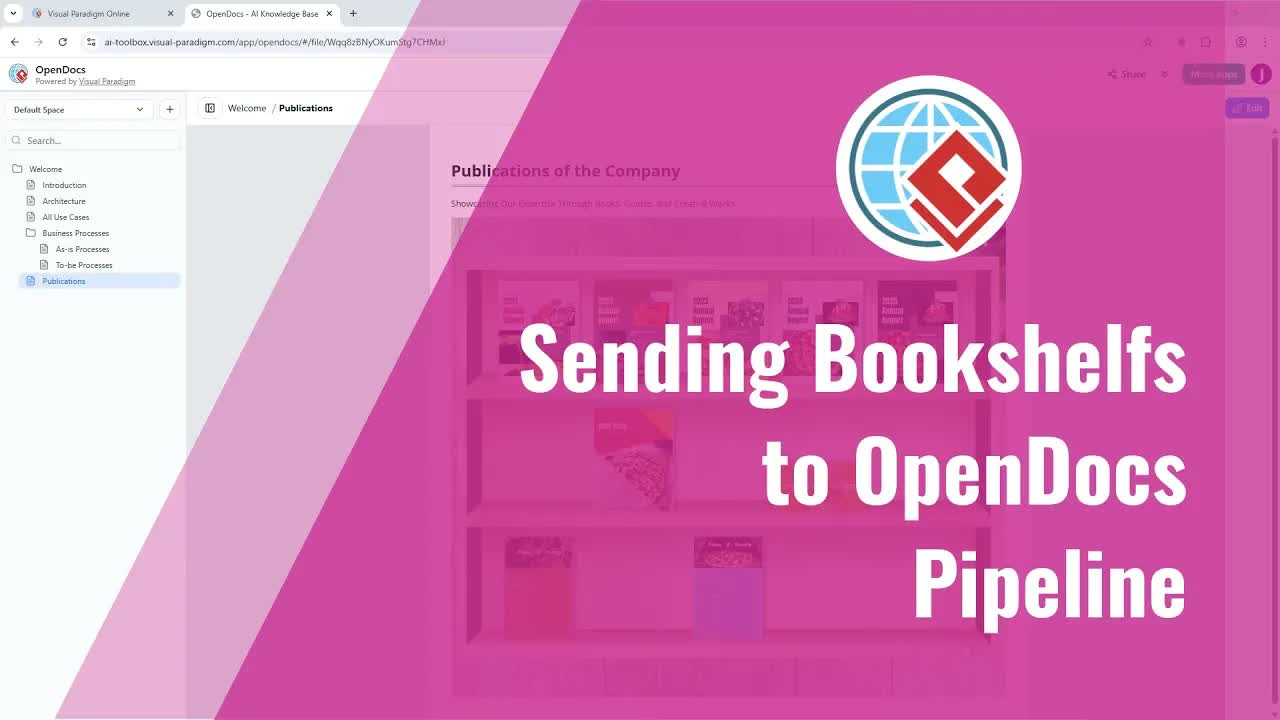
What Is OpenDocs?
OpenDocs brings document creation and visual communication together in a single workspace. You can write content, organize documents in a file system-style tree, create diagrams, generate illustrations with AI, and share completed documentation through a simple link.
Instead of writing content in one application and creating diagrams in another, OpenDocs lets you build and manage everything within the same documentation environment. This makes it easier to keep written explanations, visual models, images, and related resources connected and easy to navigate.
Key Features of OpenDocs
Markdown and WYSIWYG Editing
OpenDocs supports two writing approaches. Use the Markdown editor if you prefer a lightweight, text-based workflow, or choose the WYSIWYG editor to format content visually as you work. This flexibility makes OpenDocs suitable for technical writers, project teams, business users, and anyone who needs to create professional documentation.
Tree-Structured Document Organization
Documents are arranged in a file system-style tree structure. You can create a hierarchy of pages and subpages to organize information logically. This structure is useful for building:
- Project documentation
- Technical notes
- Product requirements
- Process documentation
- Team knowledge bases
- Training materials
- Long-term reference resources
A structured document tree helps readers find related information quickly and gives teams a consistent way to manage growing documentation.
Integrated Diagramming
OpenDocs allows you to create diagrams and mind maps directly inside a document. You can select the diagram type, open the diagram editor, build the visual from scratch, and insert it into the page when it is ready.
Embedded diagrams can make complex ideas easier to understand by visually representing processes, relationships, structures, workflows, and concepts alongside the written explanation.
AI Diagram Generation
With AI-powered diagram generation, you can describe a process or structure in plain language and generate a diagram from that description. OpenDocs can help create flowcharts, mind maps, and other supported diagram types.
After the initial diagram is generated, you can open it in the diagram editor and refine the content, layout, and visual structure before saving it to your document.
AI-Generated Illustrations and Visual Assets
OpenDocs supports a range of content assets. You can upload your own images, add content from external links, or generate illustrations with AI. These options help you enrich documentation with supporting visuals and make pages more engaging and easier to follow.
Asset Integration
You can insert work created in Visual Paradigm Desktop or Visual Paradigm Online through the pipeline. This helps teams bring existing diagrams and visual materials into a centralized documentation space.
Simple Link-Based Sharing
When a document space is ready, you can save it and share it for viewing through a link. Viewers do not need to log in, which makes it easier to distribute project information, instructions, process documentation, and knowledge resources.
How to Use OpenDocs
- Open your Visual Paradigm Online workspace.Log in to your workspace to access the available creation and AI tools.
- Open the AI app browser.Select Create with AI, then choose Browse AI Apps.
- Launch OpenDocs.Find OpenDocs in the list of available AI applications and click Start Now.
- Create and organize your documents.Build a document structure using the tree-based workspace. Add pages and arrange them according to your project or knowledge base.
- Edit the active document.Click the Edit button in the upper-right corner to open the document editor.
- Choose an editing method.Write using Markdown or use the WYSIWYG editor to create and format content visually.
- Insert supporting assets.Use the Insert option to add uploaded images, external content, AI-generated illustrations, and assets created with Visual Paradigm Desktop or Visual Paradigm Online.
- Create a diagram or mind map.Select the diagram type you need. The diagram editor will open, allowing you to create the visual manually or ask AI to generate an initial version.
- Refine and insert the diagram.Adjust the diagram as needed, then click Save and close the editor. The completed diagram will be inserted into your document.
- Edit embedded diagrams later.If changes are required, click the diagram’s Edit button to reopen it in the diagram editor.
- Save and share the documentation.When the document space is complete, save it and share the viewing link. Recipients can access the documentation without logging in.
How OpenDocs Supports Different Documentation Workflows
Project Documentation
Create a central project space for requirements, meeting notes, workflows, diagrams, decisions, and supporting resources. The tree structure helps organize information by phase, feature, team, or project area.
Technical Documentation
Combine technical explanations with flowcharts, system diagrams, mind maps, and images. This makes technical information more accessible to both technical and non-technical audiences.
Process and Workflow Guides
Describe a business or operational process in natural language, use AI to generate a flowchart, and refine the result inside the diagram editor. The final visual can remain next to the written instructions for easier reference.
Knowledge Management
Use the hierarchical document structure to build a long-term knowledge base. Related pages, diagrams, illustrations, and external resources can be maintained in one connected workspace.
Collaborative Sharing
Share completed documentation through a link without requiring viewers to sign in. This is useful when distributing guides, project overviews, process instructions, or reference material to clients, stakeholders, and team members.
Benefits of Combining Writing, AI, and Diagramming
- One integrated workspace: Create written content and visual assets without moving between separate applications.
- Faster visual communication: Generate initial diagrams and illustrations with AI from plain-language descriptions.
- Better organization: Manage related pages and resources through a structured document tree.
- More effective explanations: Place diagrams and visuals directly beside the content they explain.
- Flexible authoring: Choose between Markdown and visual editing based on your preferred workflow.
- Easier maintenance: Reopen and edit embedded diagrams whenever the underlying information changes.
- Simple distribution: Share documentation through a link without requiring viewers to log in.
Frequently Asked Questions
What is OpenDocs used for?
OpenDocs is used to create, organize, illustrate, and share documentation. Common uses include project documentation, technical notes, process guides, visual knowledge bases, and long-term information management.
Can I create diagrams directly in OpenDocs?
Yes. OpenDocs includes integrated diagramming tools that allow you to create diagrams and mind maps directly within a document.
Can AI generate diagrams in OpenDocs?
Yes. You can describe a process or structure in plain language and use AI to generate a flowchart, mind map, or another supported diagram type. The generated result can be edited before it is added to the document.
Does OpenDocs support Markdown?
Yes. OpenDocs supports Markdown editing as well as a WYSIWYG editor, allowing you to choose between text-based and visual authoring.
Can I add images and illustrations to an OpenDocs document?
Yes. You can upload your own images, add content from external links, and generate illustrations with AI.
Can I use diagrams created in Visual Paradigm products?
Yes. OpenDocs supports inserting work created in Visual Paradigm Desktop and Visual Paradigm Online through the pipeline.
Can embedded diagrams be edited after insertion?
Yes. Select the diagram’s Edit option to reopen it in the diagram editor, make changes, and save the updated version.
Do viewers need an account to view shared documentation?
No. OpenDocs documentation can be shared through a link, and viewers do not need to log in to view the shared content.
Start Creating Documentation with OpenDocs
OpenDocs provides a practical way to bring writing, AI-assisted content creation, diagramming, and knowledge organization into one workspace. Whether you are documenting a project, explaining a process, creating a technical reference, or building a structured knowledge base, OpenDocs helps you create connected and visually clear documentation more efficiently.
Start using OpenDocs to create organized documentation with integrated diagrams and AI assistance.