Creating comprehensive standard operating procedures (SOPs) and operational manuals from basic process workflows often requires extensive manual effort. By leveraging AI-driven modeling, teams can transform raw Mermaid flowchart code into refined visual models, perform quality reviews, auto-generate Markdown documentation, and publish fully synchronized knowledge bases in minutes.
1. Converting Mermaid Flowcharts into Visual Models
The transition from code-based diagramming to visual process modeling begins with direct script conversion. When managing processes—such as an airport flight check-in sequence—defined in Mermaid syntax, you can input the raw script directly into an intelligent modeling assistant.
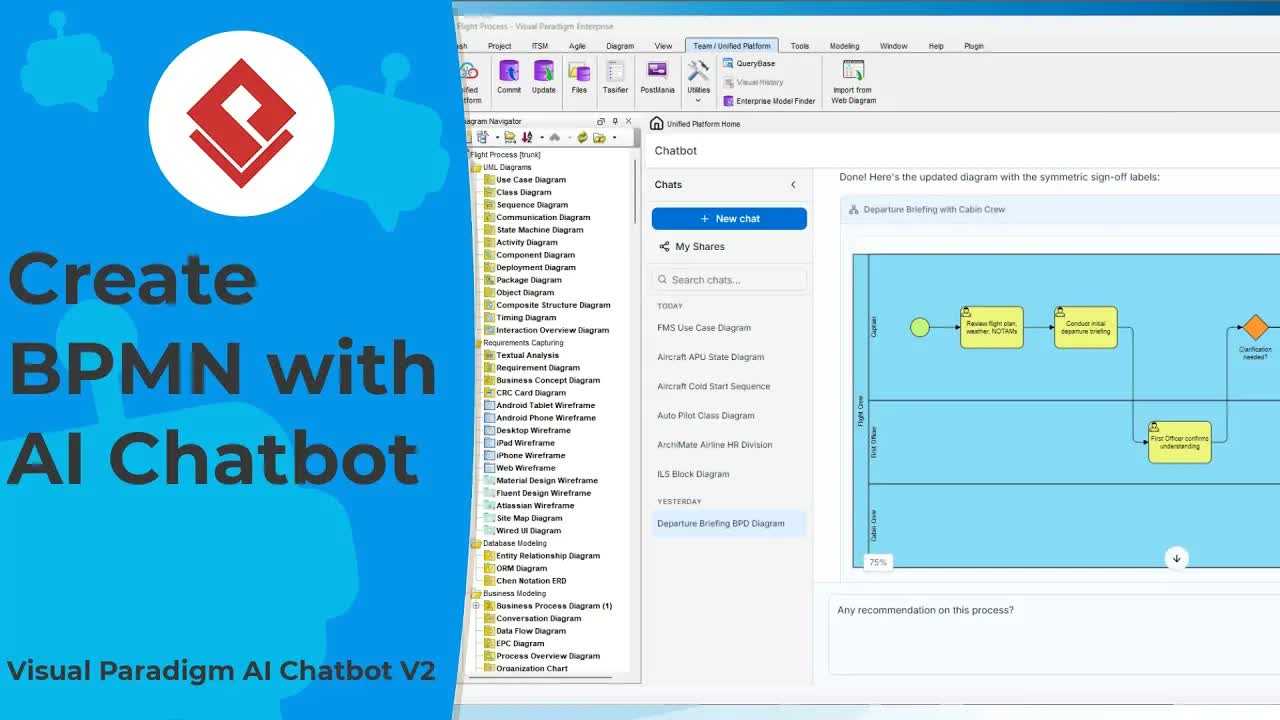
By pasting your Mermaid diagram description into the Visual Paradigm AI Chatbot, the system instantly interprets the structural relationships, decision nodes, and action paths. It parses the syntax and converts it into a clean, editable visual flowchart, removing the manual overhead of building shapes and connector lines from scratch.
2. Refinement Through Natural Language Conversations
Once your initial flowchart is rendered, process updates do not require manual shape adjustments or code rewrite. You can expand and refine business logic directly through conversational prompts.
Iterative Model Expansion
- Adding Process Exceptions: Prompt the AI to incorporate critical operational steps—such as “Add baggage security screening to the workflow”—and the canvas updates automatically.
- Handling Edge Cases: Integrate specialized pathways like “Include handling for non-standard or oversized baggage.” The AI recalculates pathing and inserts decision gates effortlessly.
This natural language interaction accelerates process evolution, enabling business analysts and operations managers to focus on procedural accuracy rather than diagram layout.
3. AI-Assisted Quality Reviews and Automated Documentation
A visual process model must be robust and error-free before turning into official operational guidance. AI-driven validation ensures your workflows meet high standards of clarity and completeness.
Automated Model Quality Audit
The AI chatbot evaluates the structural integrity of your flowchart. It highlights potential bottlenecks, missing decision outcomes, or ambiguous paths, offering actionable suggestions to elevate model reliability.
Generating Markdown Operational Reports
After finalizing the visual model, documentation generation takes a single command. Request an operational report in Markdown format, and the AI synthesizes node descriptions, decision outcomes, and step-by-step procedures into structured text ready for publication.
4. Publishing Connected Knowledge Bases via OpenDocs
Maintaining synchronization between technical process models and public documentation is critical for digital transformation and quality compliance. The Pipeline feature bridges this gap.
- Publish to Pipeline: Submit the refined diagram to Pipeline to generate a connected visual asset.
- Integrate with OpenDocs: Open a page in OpenDocs, switch to full-screen editing mode, and paste your generated Markdown text.
- Embed Synchronized Diagrams: Embed the visual flowchart directly alongside the operational text using Pipeline integration.
This creates a single, centralized operational manual where text and diagrams stay aligned. For technical teams who prefer code-level control or desktop modeling, the model can be imported directly into Visual Paradigm Desktop or exported to VPasCode for further software design and advanced development.
Ready to Accelerate Your Process Documentation?
Transforming complex workflow scripts into published, enterprise-ready operational manuals has never been faster. Experience how intelligent modeling and automated documentation can streamline your business process workflows.
Launch the Visual Paradigm AI Chatbot today to turn your Mermaid flowcharts into connected, publish-ready SOPs.